UC’s Nobel connections
Share This Article
From literature and economics to an observatory buried in Antarctic ice, UC’s connections to this year’s Nobel Prizes span disciplines and continents. Behind these achievements are teams of people — including UC staff whose expertise, dedication and everyday support help scholars pursue big ideas. The honors celebrate former UC scholars and the teamwork that helps make extraordinary discoveries possible.
Research that helps navigate economic change
UC Berkeley alumnus and former faculty member Robert E. Hall received the 2026 Nobel Prize in economic sciences for research that has changed how we think about economic stabilization during periods of volatility.
In a congratulatory note, President Milliken reflected on the importance of that work: “In a rapidly changing global economy, this award reflects the importance of research to illuminate paths to greater prosperity.”
UC teamwork behind Nobel-winning science
The research recognized by this year’s Nobel Prize in Physics also has deep UC roots. University of Wisconsin–Madison physicist Francis Halzen received the honor for his contributions to the IceCube Neutrino Observatory and the discovery of high-energy neutrinos from space.
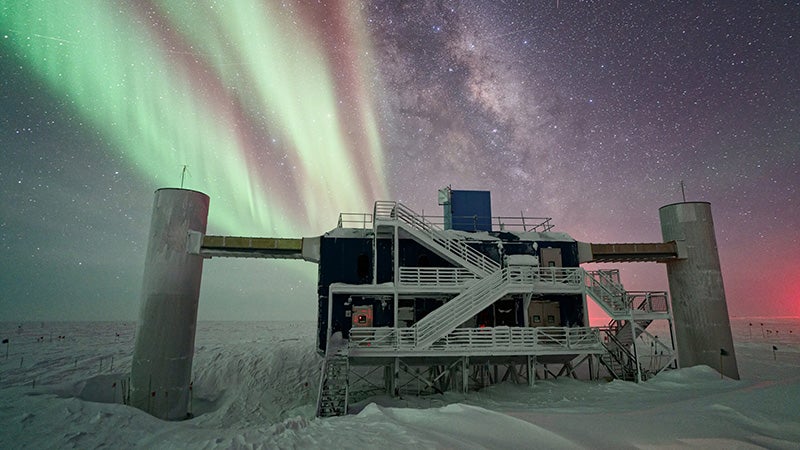
The project began through a partnership with UC Berkeley physicist P. Buford Price and his team. Berkeley Lab scientists later designed and built electronics for thousands of sensors embedded in Antarctic ice. Explore Berkeley’s role in making IceCube possible.
For more than a decade, UC San Diego’s San Diego Supercomputer Center has also supported IceCube with computing expertise and resources. Its work helps researchers simulate and interpret observations of elusive particles, opening new ways to study the universe. Learn about the computing collaboration behind the discoveries.
A Nobel poet’s chapter at UC Berkeley
Canadian poet, essayist and translator Anne Carson, winner of the 2026 Nobel Prize in Literature, has a chapter in UC Berkeley’s history. Known for blending poetry, translation and classical scholarship, Carson taught graduate seminars as a visiting professor in the 1990s and returned as the campus’s 2000–2001 Holloway Lecturer in the Practice of Poetry. Read about Carson’s time at Berkeley.
Discoveries that reach beyond the university
UC faculty have received 75 Nobel Prizes, with discoveries that continue to shape everyday life — from energy-saving LED bulbs to kidney donor matching and cancer treatments. Read why UC’s Nobel legacy matters.
What makes that work possible? Four UC Nobelists explain why UC was essential to pursuing big questions and making groundbreaking discoveries — from its research tools to its mentorship and collaborative community.
Celebrating the next generation of UC researchers: Our newest “geniuses”
The recognition extends beyond the Nobels. Two UC faculty members, two former postdoctoral fellows and an alumnus are among this year’s MacArthur fellows. Their work ranges from developing new approaches to treating disease to exploring art, history, clean energy and chemistry. To date, 104 UC faculty have received MacArthur “genius grants,” making UC one of the country’s most prolific MacArthur institutions. Meet the five new UC “geniuses” whose creativity could change the world.