
UC People: Bora Lee Reed, chief communications author and historical fiction writer
Share This Article
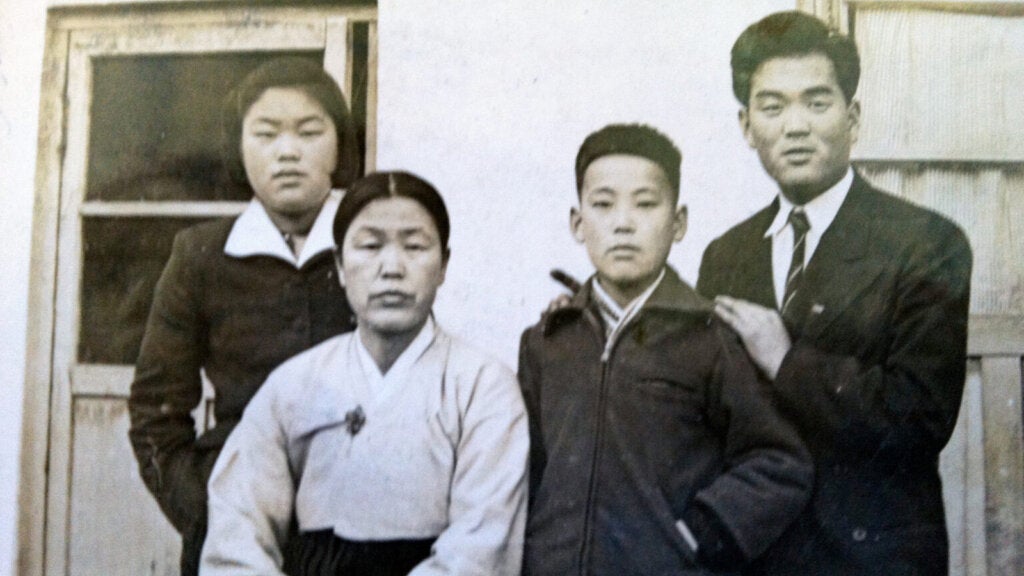
UC Berkeley author Bora Lee Reed wrote an inspiring novel based on her family’s experiences during the devastating Korean War.
The year was 1950, and the great powers of the Cold War era had begun a conflict on the Korean Peninsula that would claim as many as 5 million lives and create millions more refugees. In the U.S. today, that conflict is widely known as “the forgotten war,” but its devastation still reverberates on the tense, divided peninsula and in Korean communities around the world.
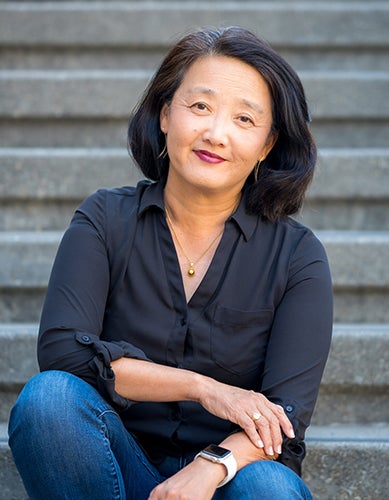
This battle-ravaged landscape is the setting for Bora Lee Reed’s memorable new novel, “Song for Another Home” (37Ink | Simon & Schuster, July 2026). “Song” is in every sense a war story, but the explosions and gunfire are always in the distance. Instead, Reed’s focus is on a family that has gotten separated in the chaos and their harrowing struggle to survive and reunite.
Reed is the chief communications officer at the UC Berkeley Goldman School of Public Policy. She holds an M.F.A. in creative writing from Warren Wilson College and a master’s degree in theology from the Graduate Theological Union in Berkeley, and was a 2023 Reese’s Book Club LitUp fellow. She’s worked at UC Berkeley for over 20 years and developed the novel throughout that time, writing in early mornings, evenings, weekends and during vacations.
In an interview, Reed explained that the story was inspired by her own family’s wartime experience — her lost grandfather, and her grandmother’s desperate flight from Pyongyang with four children.
But in “Song for Another Home,” those family memories are just threads in a fictional story of cinematic scope starring three young people, backed by a troupe of vividly drawn supporting characters. Together, they are a portrait of a country struggling to maintain its humanity in the horror of war.
UC Berkeley News interview with Bora Reed
Before we get to your book, can you tell us a little bit about the nonfiction story of how your family came to the United States?
Bora Reed: I was born in Korea. When I was a very young child in the early 1970s, the Korean War was only 20 years in the past. And so the idea that there were a North Korea and a South Korea was a relatively recent concept. I remember being a child and singing songs about longing for reunification. We really hoped our divided country could become one again.
The origin story for our families was that my grandfather was a pastor, and in a moment when they thought the war was likely over and the U.N. and South Korean forces had prevailed, he left Pyongyang, where they were living, and went off to visit rural churches that he had helped plant.
This was in 1950. While he was away, China entered the war. They pushed the United Nations and the South Korean forces south. The U.N. forces retreated in a panic. My grandmother and her four children — my dad was the oldest — waited and waited in Pyongyang until my grandfather could come back. But he never did.
A huge trauma for your family —
I didn’t experience the trauma directly, but it became a kind of origin story. And so it stayed with me.
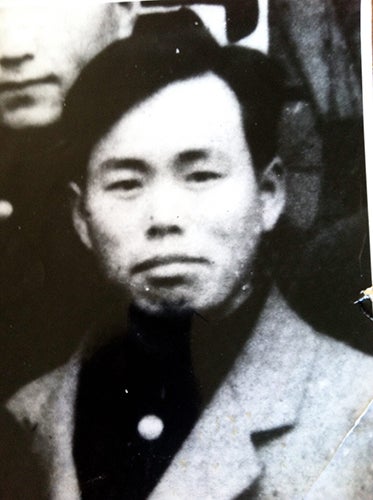
Did the family ever reunite with your grandfather?
No, they didn’t.
When I was 5, we immigrated to the U.S. My father came first to set things up for us, and then I came over with my mother and baby brother. We lived in Southern California, in L.A.
I thought that my father, who’s 91 — I thought that he had made a certain kind of peace with his lost father, because when I was a child and asked: ‘What do you think happened to haraboji? What do you think happened to grandfather?’ He would say, ‘Oh, he probably died because he was a Christian pastor living in communist North Korea during the war.’
But recently I learned that he took every opportunity to find out what happened. He petitioned the South Korean government, the U.S. government, nonprofits working with family reunification to try to figure out what happened to his father.
Even now, knowing his father isn’t alive, he still holds out hope that if North Korea opens up before he dies, he would be able to find out what happened to his dad.
Would you say that your family’s experience was the inspiration for your book?
The story, or that feeling of loss — that was the seed, for sure. “Song for Another Home” is a work of fiction. But it’s also really personal, because it started with this origin story. It started with wondering what happened to my grandfather and the pain of family separation, which is a common experience for so many Korean families of that generation.
I remember one story in particular. When my grandmother and her children were trying to get out of Pyongyang during the war and trying to cross the Taedong River, they became separated such that my grandmother and the younger children were taken across first and my father was left behind. She convinced the man with a boat to go back for her son, my father.
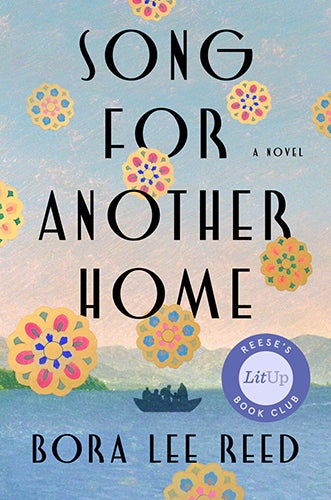
and art direction by Jackie Seow.
The thing that stayed with me, and that eventually became part of the story, is that you can make one decision under duress and it can shoot your life off in so many different directions. At my grandmother’s memorial service, my father told that story and said that if she hadn’t begged and pleaded with this guy to take his boat and go back for him, he would have been separated from her. He could still be in North Korea.
My grandmother was a very dogged person, and her doggedness and her courage kept that family together. They didn’t have my grandfather, but the rest of them stayed together for the rest of the war and continued living in South Korea.
In the novel, there are three central characters: Changho, his younger sister Oksoon, and their cousin Junho. All are trying to navigate the war while they also navigate the treacherous passage from childhood into adulthood. To what extent does their story overlap with, or parallel, the story of your own family?
Initially, I had it in my head that I wanted to write a story that would honor my parents’ generation. But at some point in the process, I realized that was way too much pressure. I needed to set those expectations aside and approach this just as a book.
In one of my first drafts, the point-of-view character was not Oksoon, it was her mother. I had the hardest time writing her. My grandmother was still alive at the time. In real life, I had a complicated relationship with her, and here I was trying to write this story. And then I had family members saying, ‘Oh, you’re writing the story of our family!’ And I’m wondering: Will my parents ever read this? If they read it, would they like it? Does this bring honor to them?
I felt like there were too many people in the room, you know? It’s so hard to write a book.
I just had to set that aside — I couldn’t be a novelist with all that baggage.
So then I thought about Oksoon, who’s on the cusp between girlhood and womanhood. I realized that she’s a flexible character. She can still be a tomboy. She could have agendas other than I have to survive and keep my family together, which was her mom’s main purpose. Oksoon could be a little bit boundary-pushing.
When I started, I didn’t know I had to not worry about who’s going to read it. I had to get to know the characters in the book, really apart from anyone who they might be a corollary to. I had to start listening to the book on its own terms and what it wanted to be. I could not carry with me the expectation of representing the family. So as much as this book is super personal and inspired by family history, in the writing I had to sort of shut the door on that for many years.
And then, when it was done, I showed it to my parents, and they read it and they loved it. That made me happy — it made me so happy.
The book has an incredible richness of sensory detail. Nature, the seasons, brutalized landscapes. The food, the smell of food and the aching absence of food. Is all of this from your imagination? In addition to mining your family story, did you have to visit Korea and mine its landscapes?
I did go back to Korea a couple of times in the course of the writing of this book, and I paid a lot of attention and made a lot of notes. But modern Korea is so different. I even went to North Korea with my dad on a relief trip. And I stood on the edge of Taedong River and I thought, This is where it happened.
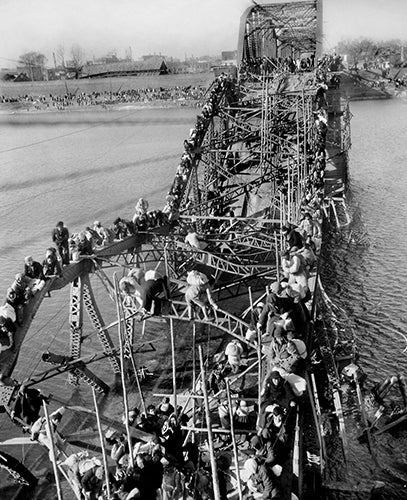
Max Desfor / Associated Press via Wikipedia
But everything looks so different. North Korea has built a large port at the mouth of that river. The landscape in South Korea is so much more industrial — it’s a completely different place.
So I looked at my family’s story. I read a lot of first-person, self-published narratives — there are many people in that generation who have these incredible stories. I stared at a lot of historical pictures of the Korean War. There’s a very famous photograph, the collapse of the bridge over the Taedong River, by Max Desfor.
I looked up maps. I just spent a lot of time staring at them, trying to get that sense of immediacy. And then the things that were more emotional — well, writers tend to think, ‘I haven’t trudged in the snow during a war, but I’ve been cold. I’ve been tired, and I’ve been hungry.’ And so you try to amp that up.
You’ve said that a part of your motivation was to honor the struggle of people who endured the trauma of the war and survived. And yet, it strikes me this is more than a Korean story. It’s a story of so many people who have come to America.
What that generation went through is so huge and so intense that yes, it does feel gratifying to be able to say, ‘I did this to honor them.’ But it also feels small in comparison. With this book, I can at least say, ‘I heard what you were saying to me. I was listening.’
So now that Song for Another Home has been released into the world — are you going to miss your fictional family and all the characters who surround them?
I already miss them. I already miss the intimacy of working on something in my imagination where the characters are with me. You know, I would sit at my desk sometimes writing and I would just start crying because… And my kids were totally laughing at me, saying, ‘Wow, you must really think you’re a good writer. You’re making yourself cry!’
But no, it’s just that you’re in that space thinking about what they’re going through and also processing both grief and nostalgia for a Korea that is past, that is gone, that I only knew when I was a small child. I think that’s an immigrant feeling, too.
Isn’t that reflected in the title of the book?
It is. A Korean American friend who read the book before it came out told me, ‘I really like the little bits of Korean poems and songs that you’ve used.’ That’s how we came to “Song for Another Home.”
When I told my father that that was the title, he said: ‘It’s beautiful — that seems to express what I feel in my heart.’
Even though the book is a work of fiction, as an immigrant, as a daughter of immigrants, there is some way that it is like a song for another home, for a past era, a past generation. But also how it feels to be an immigrant, someone who has a foot in two places, who’s very American now but still feels that heart tug for that place we left behind.