
UC Board of Regents honors exceptional faculty at inaugural Innovation Awards
Share This Article
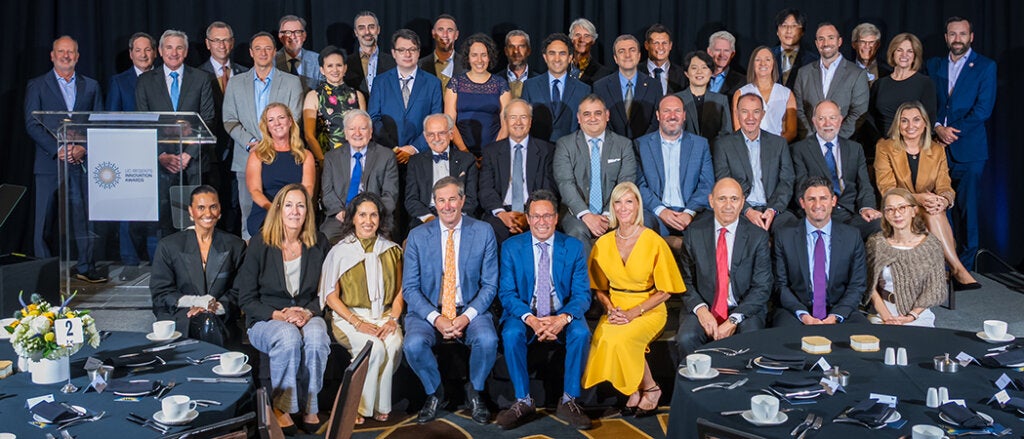
On Sept. 16, members of the UC Board of Regents launched the UC Regents Innovation Awards at a celebratory event at the UCLA Luskin Conference Center, which welcomed California public officials and leaders from across the university. Twenty-three exceptional UC innovators were chosen from a group of nominees that represented all 10 UC campuses and three affiliated national laboratories.
Celebrating UC ingenuity
The new awards recognize UC faculty, researchers, inventors, and entrepreneurs whose innovative work turns groundbreaking research into practical solutions. They highlight colleagues across the university who are making a difference in people’s lives — throughout California and worldwide.
“We established the Regents Innovation Awards with two core objectives: to further encourage our extraordinary UC community of faculty and researchers to tackle the world’s most pressing challenges, and to celebrate the trailblazing inventors and entrepreneurs who embody this spirit,” said UC Board of Regents Chair Maria Anguiano. “The visionaries we honored have demonstrated an exceptional commitment to progress through new technologies, products, and services designed to uplift the human condition.”
“The UC Regents Innovation Awards celebrate a singular strength of the University of California: the ability to turn discovery into meaningful impact,” added Regents Vice Chair Mark Robinson. “From groundbreaking technologies and new companies to research with the potential to change lives, these awards recognize the creativity, perseverance, and public purpose of UC innovators — and encourage the next generation to carry that work forward. Congratulations to this year’s winners, and I look forward to celebrating more incredible accomplishments from UC innovators in the future.”
The ceremony featured remarks from UC President James B. Milliken, UCLA Chancellor Julio Frenk, Anguiano, and UC Alumni Regent Emerita Christine Simmons. Along with current UC Regents, chancellors, and national lab directors, presenters and special guests included California State Senator Ben Allen, former California Governor Gray Davis, California State Assembly Member Jesse Gabriel, California State Assembly Member Jacqui Irwin, former Novartis CEO Joe Jimenez, and Regents Chair Emeritus Rich Leib.
Branding that reflects the promise of UC
UC Regents Innovation Awards logo
The awards logo is a visual metaphor for the transformative power of ideas across the University of California system.
At its core, the symbolic mark is partially composed of repeating lowercase letter “i”s—symbolizing innovation, ingenuity, and the individual innovators driving breakthrough discoveries. Arranged radially, these elements form a dynamic sunburst, representing enlightenment, brilliance, and the far-reaching impact of UC research and creativity. Emanating outward from a central focal point, the design captures how a single innovative spark can radiate across campuses, communities, and industries to ignite meaningful change.
Vivat Lux Award
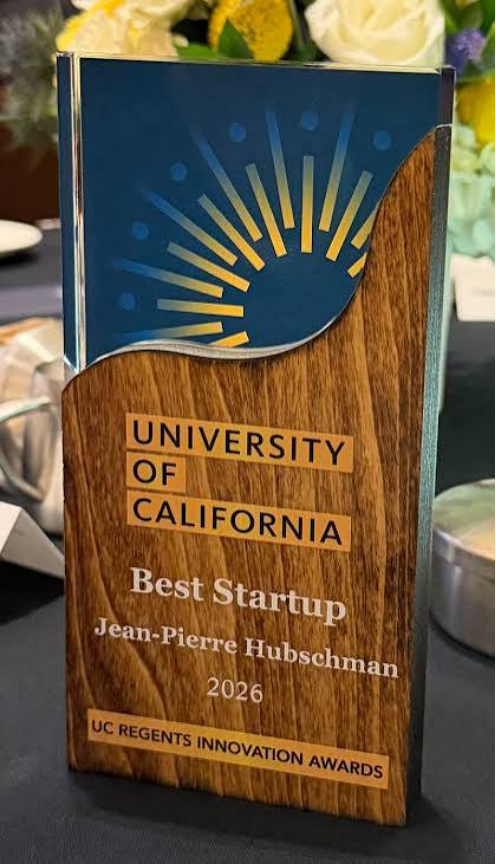
While the University of California’s iconic motto, Fiat Lux (“Let There Be Light”) calls for the pursuit and creation of knowledge, our signature award, Vivat Lux (“Long Live the Light”) celebrates what happens next.
Designed exclusively for the UC Regents Innovation Awards, the Vivat Lux award honors the visionaries who take the spark of academic discovery and ignite lasting real-world change. It symbolizes the enduring impact of ideas translated into action: research brought to market, technologies that solve humanity’s greatest challenges, and innovation that continually brightens the world.
Congratulations to this year’s winners and nominees
The UC Regents Innovation Awards recognized up to three winners selected from across UC’s 10 campuses and three national laboratories in five categories: Gamechanger Award, Disruptive Research Award, Best Startup Award, Community Changemaker Award, and Distinguished Lifetime Achievement Award. Winners in the Gamechanger, Disruptive Research, and Best Startup categories each receive a cash prize to support their continuing excellence.
“Innovation at UC takes many forms, and these awards were created to showcase the full breadth of that work,” shared UC Regent Lark Park. “We’re proud to recognize researchers translating ideas into practice, entrepreneurs addressing urgent societal needs, community partners strengthening the innovation ecosystem, and leaders whose lifetime contributions have shaped modern life. Each nominee for this year’s awards has made significant contributions to the public good, and it was not an easy task to select winners from this distinguished group of UC scholars and partners.”
This year’s winners are listed below. Select each person’s name to review their nomination video. You can also explore the full list of 2026 nominees.
Gamechanger Award
Honors inventors who have successfully brought a high-impact product or service to market.
- Michael Leon, UC Irvine: Developed Memory Air, a medical device that delivers natural scents to older adults during sleep. His olfactory-enrichment method improves deep sleep and boosts memory outcomes, offering an accessible, noninvasive therapy for patients living with dementia.
- Kevan Shokat, UC San Francisco: Discovered a hidden binding pocket on the KRAS protein. This breakthrough led to the first FDA-approved drugs to inhibit out-of-control cell growth caused by mutated forms of the KRAS gene, reshaping how scientists develop therapies for some of the world’s deadliest cancers.
- Fyodor Urnov, UC Berkeley: Leads the development of on-demand gene-editing treatments for children born with rare genetic disorders. His team established a framework that cuts the development cost of personalized CRISPR cures by 90%, opening the door to new, scalable, and accessible treatments for families around the world.
Disruptive Research Award
Highlights early-stage, use-inspired breakthroughs capable of transforming whole fields.
- Chang C. Liu, UC Irvine: Invented OrthoRep, an artificial DNA replication system that accelerates targeted protein evolution. His system compresses biological evolutionary timelines from years to days, enabling researchers to rapidly engineer new therapeutic proteins and cancer-fighting antibodies.
- Susan Lynch, UC San Francisco: Established a new paradigm for preventing food allergies, asthma, and other conditions caused by immune system malfunctions. In clinical trials of a living microbial therapy that boosts healthy gut microbes in infants, atopic dermatitis decreased by 64% and food allergies by 77% in high-risk infants.
- Aydogan Ozcan, UCLA: Leading researcher in AI-powered computational imaging, sensing, and optical computing. His work harnesses the physics of light to perform AI computations, paving the way for more sustainable, energy-efficient AI and expanding access to next-generation intelligence beyond traditional data centers.
Best Startup Award
Recognizes spin-off companies built directly on UC research or intellectual property to deliver societal value.
- Joseph DeRisi, UC San Francisco: Founded Delve Bio to pioneer a metagenomic test that diagnoses complex central nervous system infections when conventional testing fails. Its flagship service, Delve Detect, reduces unnecessary procedures, shortens hospital stays, and gives hospitals nationwide access to advanced infectious disease diagnostics and expert neurological consultation.
- Jean-Pierre Hubschman, UCLA: Founded Horizon Surgical Systems to create an AI-assisted robotic platform that automates complex eye surgeries. His technology standardizes surgical precision, expands access to sight-restoring procedures, and has created 60 high-skill jobs in Southern California.
- Erika La Plante, UC Davis: Co-founded Equatic, a company behind an industrial process that uses seawater to capture atmospheric carbon while producing clean hydrogen fuel. The technology is a scalable system for permanent ocean carbon removal and green energy production.
Community Changemaker Award
Spotlights external collaborators who help bridge the gap between university labs and the public marketplace.
- Bud Colligan: Established the Colligan Clinical Diagnostic Laboratory at UC Santa Cruz to provide regional COVID-19 testing and support pediatric disease research. Through early investments in Digital NEST and Central Coast Angels, he channels capital into California’s Central Coast to create technology jobs for local youth.
- Josh Green: Established UCLA Ventures as an entrepreneurial community. Leveraging a unique equity-pledge model, UCLA Ventures connects early-stage founders with investments and resources. His mentorship network accelerates the growth of regional startups and channels financial resources back into university research.
- Elizabeth Redman Cleveland: As chief strategist for sustainable growth for the City of Berkeley, Calif., she has expanded the city’s innovation sector to nearly 370 technology companies. Through her Berkeley Ventures, Berkeley Values initiative, she builds pathways for youth to access STEM careers and connects civic-tech growth with community prosperity.
Distinguished Lifetime Achievement Award
Pays tribute to a lifelong commitment to tech transfer, commercialization, and mentorship.
- John Bowers, UC Santa Barbara: Integrated laser technology directly onto silicon chips, multiplying fiber-optic data transmission rates by a factor of one thousand. He founded seven technology startups, leads the Institute for Energy Efficiency, and co-founded the nonprofit Unite to Light to distribute solar power to off-grid communities.
- Jean-Claude Falmagne, UC Irvine: Pioneered modern cognitive theory that explains how students achieve mastery. That work led him to found ALEKS, an online learning platform used by over 50 million students that quickly assesses what students already know and what they are ready to learn in math, chemistry, statistics, and more.
- Richard (Ed) Green, UC Santa Cruz branch of QB3: His innovations in DNA sequencing have led to breakthrough discoveries about human evolution — including a draft sequence of the Neanderthal genome — and forensic applications that have helped solve cold cases around the country through his company, Astrea Forensics. Green also founded two startups, Dovetail Genomics and Claret Bioscience, at the UC Santa Cruz branch of the California Institute of Quantitative Biosciences (QB3), which he now leads.
- Stephen Hauser, UC San Francisco: His discovery of the central role of B cells in multiple sclerosis has been the basis for three revolutionary drugs to treat the disease: rituximab (Rituxan), ocrelizumab (Ocrevus), and ofatumumab (Kesimpta). Hauser is also a senior medical advisor for Neurona Therapeutics, a UC San Francisco–founded biotech company developing neural cell therapies for neurological diseases.
- Michael Jung, UCLA: His research led to the invention of two FDA-approved prostate cancer drugs, Xtandi and Erleada, which have extended the lives of over a million men worldwide. Licensing revenues from his discoveries continue to fund student scholarships and scientific research across the university.
- Jay Keasling, Lawrence Berkeley National Laboratory — Joint BioEnergy Institute: By engineering microorganisms to produce biofuels and chemicals, Jay Keasling not only helped launch the field of synthetic biology but also created artemisinin, a powerful antimalarial drug. He has founded or co-founded 12 startups that have raised more than $2.37 billion in funding and holds 75 issued patents.
- Mikeal Roose, UC Riverside: Used citrus genetics to develop several new mandarin varieties, including the virtually seedless Tango, an easy-to-peel fruit — often found under the names Wonderful Halos, Cuties, or Delite — which has put the mandarin on pace to be the best-selling U.S. citrus. His research also targets huanglongbing (citrus greening), a major threat to the citrus industry worldwide.
- Justin B. Siegel, UC Davis: His research focuses on the design and discovery of enzymes for a wide range of applications, including therapeutics development and fuel or chemical production. He is a co-inventor on more than 100 global patents and a founding member of six companies, including PvP Biologics, whose gluten-digesting enzyme technology was acquired by the pharmaceutical giant Takeda, and Peak B, which developed a natural blue food coloring for the food industry.
- Jennifer Smith, UC San Diego: Her research at the Scripps Institution of Oceanography develops cutting-edge techniques for studying and restoring marine ecosystems, such as 3-D imaging of coral reefs. She co-founded the California Seaweed Co., a culinary seaweed startup, and is developing commercial-scale seaweed aquaculture, including cultivating a red seaweed with CH4 Global to reduce methane emissions from cattle.
- Alberto L. Sangiovanni-Vincentelli, UC Berkeley: Pioneered tools that launched the electronic design automation industry. By co-founding Cadence and Synopsys and sharing his software models globally, he enabled the automated chip design that powers modern computing, communication, transportation, consumer, and health care devices.
- Christopher M. Spadaccini, Lawrence Livermore National Laboratory: Developed more than 50 patented technologies to create new materials that conventional manufacturing cannot achieve, such as materials that are both lightweight and exceptionally strong. He has founded several LLNL fabrication laboratories and led an 18-month collaboration with Autodesk to advance next-gen 3-D printing for objects like protective helmets.
Learn more about the UC Regents Innovation Awards
- Explore winners’ stories, including the work that led to their being honored by the UC Board of Regents.
- Get the answers to frequently asked questions about the awards.
- Review the nomination forms and criteria.
The University of California is not only committed to being one of the world’s cradles of academic discovery, but also to being the best at translating big ideas into real-world solutions the public desperately seeks. From curing disease and eradicating hunger to reversing climate change and improving quality of life, UC is a powerful engine for innovation, change, and societal good.
These inspiring colleagues’ work contributes to making UC the No. 1 public university for academic research with the most influential scientists and a world record for Nobel Prizes. Learn more about UC and explore our impact.