
A lifetime of island stewardship: UC honors Lyndal Laughrin with new staff award
Share This Article
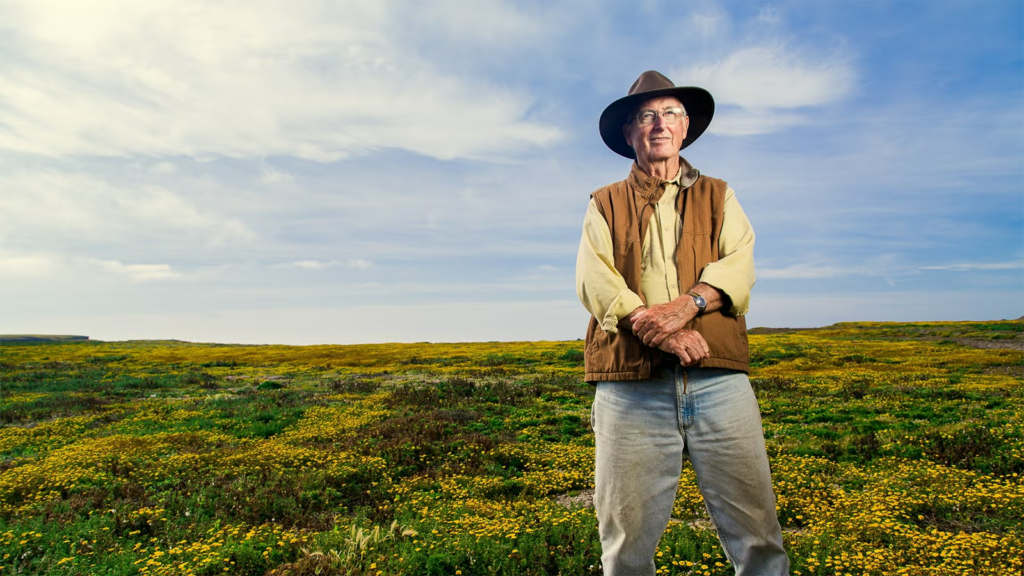
With its wildflower meadows, rugged coastlines and night skies unspoiled by city lights, UC Nature’s Santa Cruz Island Reserve offers a glimpse of a California few people have experienced.
Perhaps no one knows this extraordinary place as intimately as Director Emeritus Lyndal Laughrin and his wife, Ann Bromfield, who devoted 56 and 40 years respectively to caring for the reserve and helping others discover what it can teach us. Two of the island’s longest-term inhabitants, Laughrin — also UC Nature’s longest-serving employee — and Bromfield have helped generations of scientists, students and visitors understand its wildlife, landscapes and history.
In September, UC Nature recognized Laughrin’s service with a new award bearing his name. The UC Nature Lyndal Laughrin Distinguished Stewardship and Service Award honors staff whose leadership and lasting contributions support the network’s mission — “to contribute to the understanding and wise stewardship of the Earth and its natural systems by supporting university-level teaching, research, and public service at protected natural areas throughout California.” Laughrin received the inaugural honor, which includes a $1,000 award.
Video by The Current, UC Santa Barbara
A lifelong passion
Laughrin first arrived on Santa Cruz Island in 1965 as an assistant instructor for a UC Santa Barbara geology course. He would go on to earn all three of his degrees — a bachelor’s, master’s and doctorate — at UC Santa Barbara, with the island becoming central to his scientific research. When the field station’s director left in 1970, Laughrin stepped in, bringing scientific curiosity and considerable resourcefulness to the role.
Living offshore with Bromfield, whom he married in 1986, required careful planning. Over the years, their transportation to the island involved Navy boats, ferries and small chartered planes, with supplies ranging from groceries to construction materials, fuel and auto parts.
Keeping the reserve running also meant becoming a mechanic, electrician and plumber, navigating rugged roads and, during the island’s ranching years, helping with cattle roundups and branding.
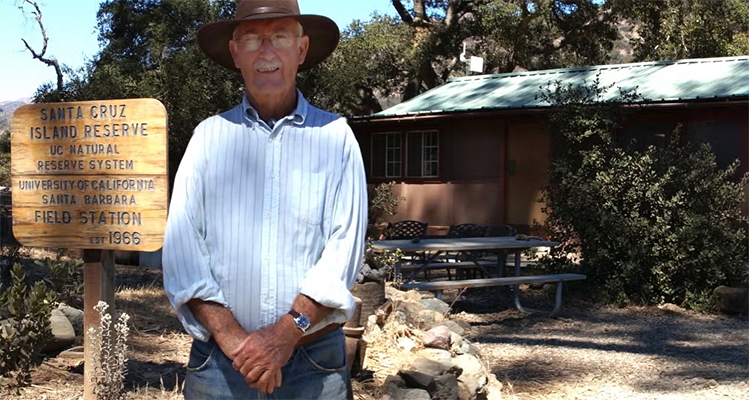
For visiting researchers, Laughrin and Bromfield’s willingness to lend a hand could make an enormous difference. By recording observations and tending experiments between other scientists’ visits, they saved costly, time-consuming trips to and from the mainland. Their knowledge of the island’s foxes, jays, oaks, geology and human history helped researchers make the most of their time in the field.
That familiarity never dulled the sense of discovery.
“The views are different at different times of day, during different seasons or weather, and from different angles,” Laughrin told UC Santa Barbara’s The Current. “It’s like looking through a kaleidoscope. You turn it and things shift themselves around. And you never tire of what comes next.”
“I think the island has a spiritual connection with Lyndal and Lyndal with the island, and that is where he blossoms and flourishes and finds the best of himself, and at the same time, he brings out the best in the island,” said Steve McCormick, former CEO of The Nature Conservancy, during a 2018 interview.
A shared commitment to an extraordinary place
Across their decades on Santa Cruz Island, Laughrin and Bromfield witnessed a remarkable transformation. Once used for cattle ranching and sport hunting of sheep and boar, the island became a focus of conservation through the UC’s partnerships with The Nature Conservancy and the National Park Service.
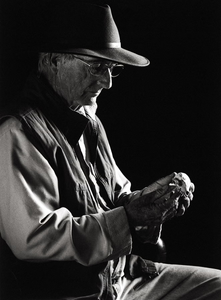
Land once heavily grazed by livestock began to recover. Native vegetation reclaimed ground. Research helped guide decisions about the island’s future.
When fox populations plummeted in the 1990s, recovery depended on addressing threats across the ecosystem. Laughrin assisted with restoration efforts that included removing nonnative grazing animals and relocating golden eagles, which preyed on the foxes.
Laughrin’s own studies contributed to one of its most celebrated recoveries: that of the Channel Islands fox, a small relative of the mainland gray fox. He began studying the animals as a graduate student, developing an understanding of their behavior and needs that would later support efforts to save them.
With Laughrin serving a pivotal role, research organizations and scientists worked together to bring the animals back from the brink. Listed as endangered in 2004, with a scant 300 remaining, the Channel Islands fox was removed from the federal list in 2016 with a population of more than 1,800. This was the fastest successful recovery of any mammal listed under the Endangered Species Act.
A lifetime of discovery, a lasting influence
Collaborations like the one that restored the fox drew on the relationships Laughrin and Bromfield nurtured over decades. Laughrin’s patience and easygoing manner helped him build trust with researchers, island neighbors and conservation partners, while his enthusiasm welcomed newcomers into the island’s story.
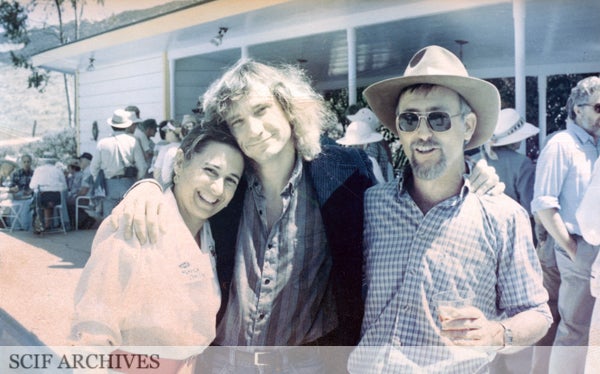
Over the years, visitors ranged from student groups to astrophysicist Stephen Hawking, former British Prime Minister Margaret Thatcher, musician Ringo Starr and actress Jane Fonda. Whatever the background of the island’s travelers, they met guides with an intimate understanding and an enduring enthusiasm for sharing it.
The UC Nature Lyndal Laughrin Distinguished Stewardship and Service Award recognizes the many forms that staff dedication can take: knowledge built through years of observation, practical help that keeps research moving and relationships that make lasting conservation possible. Through Laughrin’s example, it also celebrates the people who inspire others to carry the preservation work forward.
Learn more about Lyndal Laughrin and Ann Bromfield
In 2018, Laughrin and Bromfield received the UC Natural Reserve System Distinguished Service Award.1 Watch the video below.
Video by UC Nature
For more details about Laughrin’s time at the reserve, including behind-the-scenes photos and video, read “Stewards of Nature: Santa Cruz Island.” You can also explore Laughrin’s Islapedia page, for photos and oral histories of his experiences, and read Laughrin’s profile by the LA Times.
- The UC Natural Reserve System was renamed UC Nature in 2026. ↩︎