For UCLA’s Kate Caldwell, voting access is personal
Share This Article
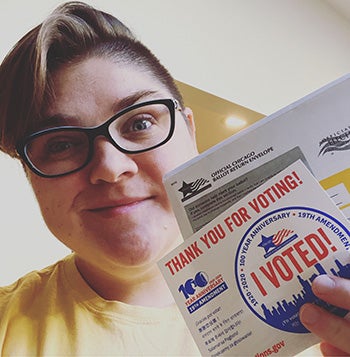
Kate Caldwell knew her great-grandmother had been a suffragist in rural Alabama. But this year, while researching voting rights, she discovered another part of her family’s history — one that put that legacy in a more complicated light.
More distant relatives had ties to the Dixiecrats — a short-lived political party founded in 1948 by conservative white Southern Democrats — and to the legal challenge that became Shelby County v. Holder, a case in which the Supreme Court struck down the Voting Rights Act’s preclearance formula, eliminating federal oversight of election law changes in jurisdictions with a history of racial discrimination and enabling a nationwide wave of restrictive voting laws.
“One part of my family history reflects efforts to expand access to political participation and education, while another reflects efforts to restrict it,” she says.
Caldwell, director of research and policy at the Collective for Racial & Disability Justice (CRDJ) at UCLA School of Law, made the discovery while studying voting-rights history, including the work of Black disabled leaders like Fannie Lou Hamer. Finding her own relatives in that history gave her longstanding work on voting access new urgency.
“As I grappled with what I had learned, I found myself thinking about how each generation inherits both victories and unfinished work,” she says. “This lit a fire under me.”
The discovery helped shape her work on CRDJ’s Political Disablement report and deepened her commitment to protecting and expanding voting access.
“As a disabled voter I have experienced firsthand how changes that improve accessibility can make political participation possible,” she says.
Helping people exercise their rights
At CRDJ, Caldwell examines the gap between having rights and being able to use them. Her work asks “who gets to participate in the decisions that shape our lives, and what happens when rights exist on paper but remain difficult to exercise in practice.”
She helps bridge that divide by making research, law and policy easier to understand and use. That includes explaining how policy changes affect people’s ability to vote, raising awareness about voting rights and accessibility and helping people find ways to advocate for themselves and their communities.
“I help people understand their rights, how policy works, and where they have opportunities to participate,” she says.
CRDJ is also working with partners to examine voting rights in the context of guardianship, where questions about legal capacity and disability can determine who has a voice at the ballot box. Across these efforts, Caldwell’s goal is to help people access the information they need to make decisions that affect their lives.
Practicing democracy together
For Caldwell, voting connects the work of earlier generations with the choices people face today.
“Generations of people fought to expand the boundaries of citizenship and political participation,” she says. “Exercising those rights is one way we carry that work forward while taking responsibility for the choices our democracy makes now.”
She sees voting as both a right and a responsibility — an opportunity to help decide what kind of society people want to live in and what direction the country should take. Sitting out an election still has consequences.
“When we choose not to participate, those decisions do not stop being made,” she says. “Rather, we leave more of them to others to make for us instead of with us.”
That sense of shared responsibility runs through her research, her advocacy and her decision to vote.
“My work has taught me to think about citizenship not as something we possess, but as something we practice together,” Caldwell says. “Voting is not the whole of democracy, but it is one of the ways we take responsibility for its direction and for the society we are building with one another.”