
UC People: Eric Askins, building the future of education
Share This Article
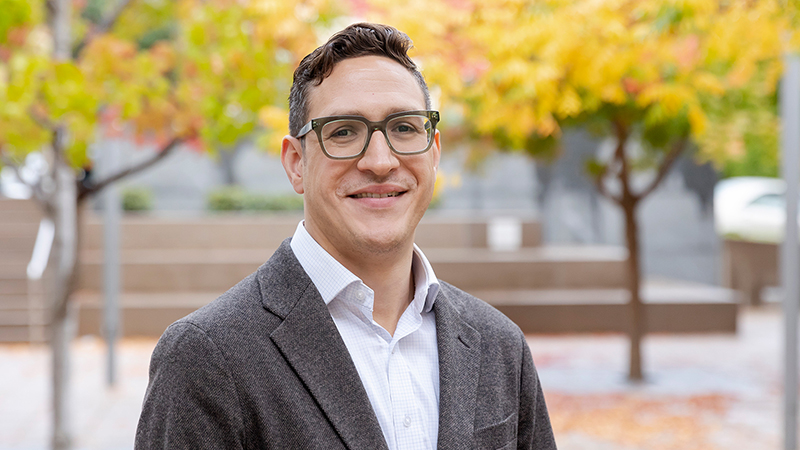
By Gwyneth K. Shaw, UC Berkeley Law
Speed matters to Eric Askins. But his mantra isn’t the “move fast and break things” motto of Silicon Valley. He’s focused on agility — progressing quickly, but with a laser focus on making the right steps at the ideal time.
Over more than 15 years in higher education administration, including seven at UC Berkeley’s Haas School of Business, Berkeley Law’s new Assistant Dean for Initiatives and Innovation has thrived in dynamic, cutting-edge environments. The chance to bring that to the law school was a huge draw when Dean Erwin Chemerinsky offered him the job.
“The thing that was most exciting about this was the opportunity to continue to build towards what the future of education looks like,” Askins says.
Now, his portfolio includes Berkeley Law’s Executive Education Program and the school’s Leadership Academy, a top priority of Chemerinsky’s that’s designed for students hoping to serve society in an array of leadership roles, from government officials and judges to nonprofit executives and startup founders.
The role also comes with a challenge: to create and build other new programs that further expand the public mission-driven reach of Berkeley Law.
“One of the most amazing things about thinking beyond the confines of a degree program is how big a community that you can serve,” Askins says. “Looking across the landscape here, over 6,000 people outside of degree programs have been served and we’ve granted more than 4,000 certificates.”
He adds, “These are people that are lifelong learners, who are interested in engaging with the amazing scholarship that’s being produced at this institution, and getting access to the amazing network that we connect to. Not only are our programs being delivered by lecturers and faculty within Berkeley Law, they’re also being delivered by people in industry that we have access to because of our location, because of our footprint, because of our reputation, because of our network.
“And what excites me is that we can create offerings and connect people to scholarship and knowledge at different price points across different ecosystems.”
Chemerinsky says Askins is an ideal fit for the job.
“I am thrilled that Eric Askins has joined us in our new position of Assistant Dean for Initiatives and Innovation,” Chemerinsky says. “Eric is superbly qualified for this role which will include responsibility for executive education, our leadership program, and new efforts to create exciting programs for the law school.”
Broad horizons
Askins, who began his education career in the admissions office at Fordham University School of Law, says another major attraction was the opportunity to work with law students again.
“I’ve had amazing experiences learning and growing alongside law school students,” he says. “They’re one of my favorite populations, and the ability to serve that population again here at a different point in my career with the different set of tools at my disposal was something I couldn’t pass up.”
As he settles into the job, Askins is also analyzing Berkeley Law’s current executive education offerings, from the free Berkeley Boosts webinar series to paid courses like GenAI for the Legal Profession: Power User Edition, ESG University, and the brand-new Chief Privacy Officer Program.
“We get not only our alumni, who are an amazing part of our community, but also people from far afield, people who are not even in the legal profession but can gain knowledge from us and gain value from that experience,” he says.
These programs are inherently flexible, making them ideal for giving potential students exactly what they need to keep up with the rapidly changing legal profession. For example, Askins says, the generative AI course served over 1,000 people in its first two years, and has now been completely revamped.
“Having worked primarily with degree programs, the constraint there is you’ve got accreditation bodies, you’ve got a lot of stakeholders involved with the way in which you’re going to deliver that material, what the pedagogy is, what the delivery system is, who has access to that material in this environment,” he says. “With non-degree programs, we can meet the market where it is. You can get input, you can pivot, you can make changes.
“And some of what we’re learning here are things that we can apply in other spaces.”
That includes the Leadership Academy, whose participants receive an extra $10,000 scholarship per year on top of their existing gift aid award. The program also offers training to effectively lead people and solve problems in both the public and private sectors.
Askins has been spending time with current academy students, listening to their experiences so far and hearing what they hope to gain from the program.
“I see the Leadership Academy as a laboratory — I view it as an opportunity for us to bring some concepts that I’ve worked with in the past to this student body and this ecosystem,” he says. “We can track what works and what doesn’t, hear what we might need to adjust or develop, work with graduates of our program here to understand what they’ve used to navigate their early professional lives and their mid-career professional lives, and what stories we want to bring back in.”
Askins also sees the potential for building an even stronger relationship between the law school and Haas, beyond the existing J.D./MBA program, another element of his portfolio.
“There are opportunities to take some of the things that I got to work with in the business school around leadership, some of those concepts and ideas, and tapping into some of the folks who work in those spaces who might be able to come across the parking lot and deliver a course and deliver a seminar. I want to actually create infrastructure and connection between the two.”
In addition, he wants to deepen Berkeley Law’s connection with its alumni as continuing learners, reframing “executive education” as a more inclusive area.
“Not everybody perceives themselves as an executive or aspires to be one, but everybody wants to continue to learn in some way, shape, or form,” he says. “And they may decide coming back to their alma mater might be a great way to do that, because there’s already the reputation and already the community here.”
It’s a lot to take on, but Askins is in his comfort zone.
“When I was hired, it was with a specific focus, obviously, on innovation,” he says. “But it’s really about building towards the future. To be able to bring a cutting-edge approach to the law school space — which is not traditionally seen as being a place where you’re going to get the sort of dynamic, creative thinking you see in other sectors — is really exciting to me.”