
UC ANR creates new report highlighting agriculture and natural resources sectors’ vital role in California’s economy
Share This Article
By Caroline D. Champlin, UC Agriculture and Natural Resources
Last year, California surpassed Japan to become the world’s fourth-largest economy. Contributing to that achievement are over a million farm laborers, winemakers, park rangers, agricultural truckers, renewable energy technicians and many other workers who generate value from the state’s natural landscapes.
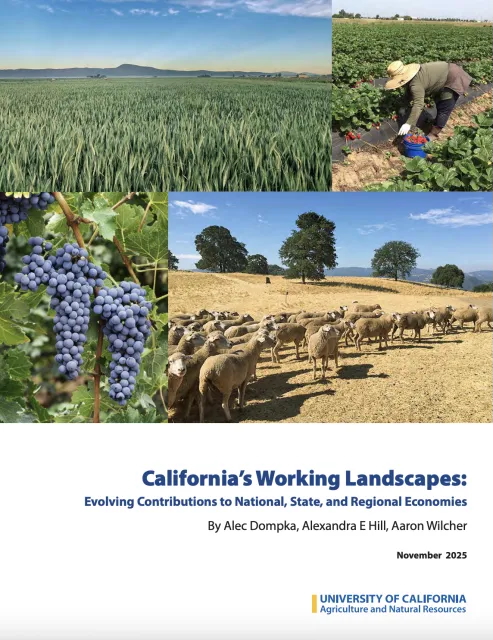
Academics from University of California Agriculture and Natural Resources have done the math on the economic scope of these working lands, compiling their findings in the publication “California’s Working Landscape: Evolving Contributions to National, State, and Regional Economies.” This new report includes the latest data on state employment, earnings, sales and businesses, providing an update to the first edition of this report, released in 2019.
Working landscapes encompass land areas actively managed for economic purposes, primarily agricultural lands, forests and rangelands, as well as the land and water areas that create economic value, like those used for fishing, renewable energy production, mining and outdoor recreation. In total, those working landscapes support nearly 1.5 million jobs and 75,500 businesses while generating $404 billion in sales and providing $103 billion in worker earnings.
When it comes to the farming sector, the report demonstrates a simple fact: the Golden State is an agricultural behemoth. Business establishments across the state’s four agricultural sectors – agricultural production, support, processing and distribution – generated $310.8 billion in sales and contributed more than 1.2 million jobs in 2024.
Those numbers affirm California’s rank as the nation’s most agriculturally productive state.
“This report once again shows how our working landscapes are critical as a foundation of the California economy,” said Glenda Humiston, UC vice president for agriculture and natural resources. “It also underscores the importance of continuing to invest in agriculture, natural resources and related industries to maintain California’s position as one of the world’s economic powerhouses.”
According to the report, the most common jobs affiliated with California’s working lands help produce our food supply, including positions in agricultural support, production, processing and distribution. The agricultural supply chain is linked across California’s geography, with hubs of activity in the Central Coast, San Joaquin Valley, Bay Area and Los Angeles regions.
The report proves the benefit of keeping a close eye on the economy over time, according to co-author Alexandra Hill, an agricultural economist and UC Berkeley professor of Cooperative Extension.
“It’s pretty crucial to analyze data over multiple years,” Hill said.
For instance, this report picked up on a recent surge of agricultural support jobs, positions that provide speciality support to farmers, like fertilizer retailers or business consultants. In Hill’s interpretation, this uptick in agricultural support roles could be related to anecdotal evidence of more farmers securing labor through contracting businesses, rather than directly recruiting farmworkers themselves.
Hill hopes the report will reach stakeholders – including the diverse cross-section of experts employed by UC ANR – who can lend their own experience to tease out new research questions based on the data.
“There are just many different ways that you can divide this report. There are many possible avenues we can take this work in,” Hill said.
Besides demonstrating the impact of California agriculture, the report encompasses other natural resource sectors, including mining, outdoor recreation, fishing and renewable energy. The report provides national context by ranking the valuation of these sectors in multiple states. The results place California in the top five of every category included, and in most cases, first place. The state leads in the four agricultural sectors, outdoor recreation and renewable energy.
“That was useful to see California emerge as one of the top contributors across most sectors,” Hill said.
Notably, the report highlights California’s huge growth in the renewable energy sector, which includes solar, wind and geothermal. The state’s latest accolades: ranking first nationwide in renewable energy business, sales and earnings. The renewable energy sector is the fastest-growing working landscape included in the report.
In addition to Hill, the report was co-authored by Alec Dompka and Aaron Wilcher, UC Cooperative Extension advisors on the Community Economic Development team.